



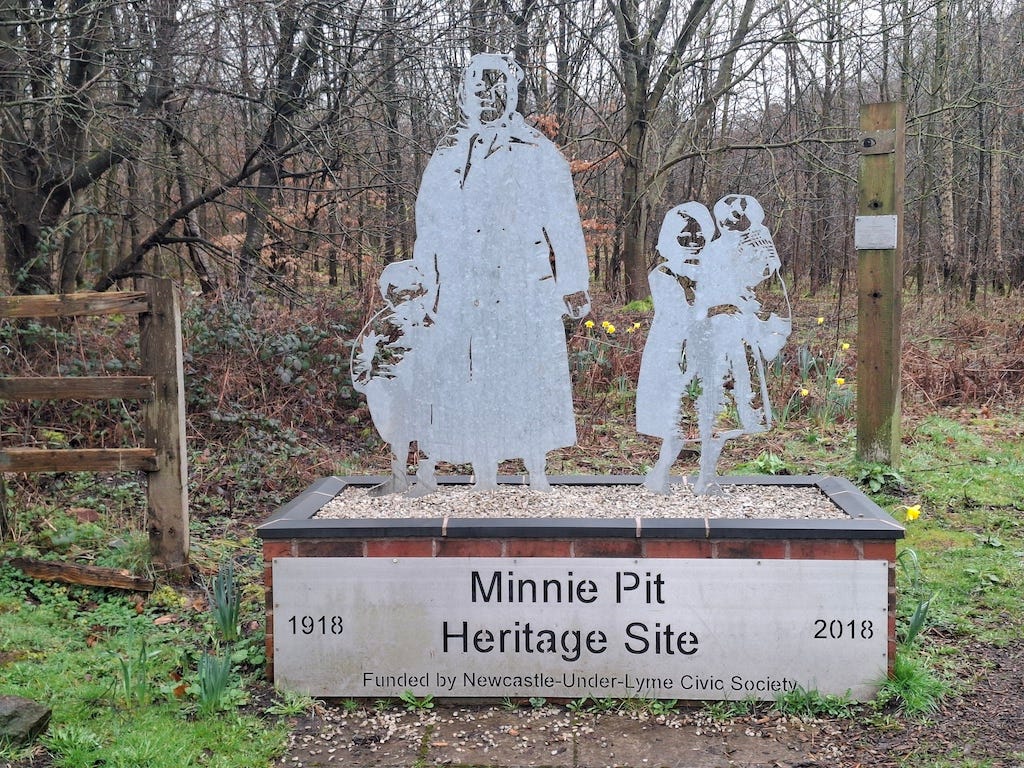
Separated by less than 5km, Silverdale and Halmer End have both been sites of tragedy and despair for Newcastle residents, most catastrophically when 155 men and boys were killed following an underground explosion at Minnie Pit in 1918, the same year that Germany signed an armistice ending the war and the flu killed up to 100 million people worldwide. Six years after the disaster in 1924, the site of Walley’s Quarry was being used for clay extraction but it wasn’t repurposed for landfill in 2007, 10 years after permission was initially contested. What followed was 17 years of insufferable stench for Silverdale’s residents until it was ordered to close in 2024. For me, this tragic history holds the seeds for a brighter future.
For a number of years I lived in Silverdale, and even now the bus that gets me to town passes through. As it glides past I inevitably see the same things: my old house, the library, the new housing estate where my friends lived, the shops. These things are a stake in time. Seeing them, it’s like the past is still the present, with the future circling back to it. I have to remind myself that things are always changing. The shops are different. My mates have moved away.
Of course, time never stands still, but sometimes it accelerates. Not long after I moved away residents started noticing a smell. Then pets began to die, and children became sick. Walley’s Quarry, it was discovered, had quietly been inflicting environmental terrorism on the residents of Silverdale for years with its landfill. So a grassroots campaign gathered to Stop The Stink. Years passed, and the Environmental Agency was eventually bullied into doing its job. The landfill was given a closure notice, and then its company collapsed. Years of toil and pain, but only the barest and most indirect form of justice was delivered for Silverdale’s community.
I have to remind myself that the last deep mine in North Staffordshire closed four years before I was born, in Silverdale, in 1998. The placement of that year is not lost on me. A new millennium had started, and the future needed to arrive. But that future would start in some places far earlier than others.