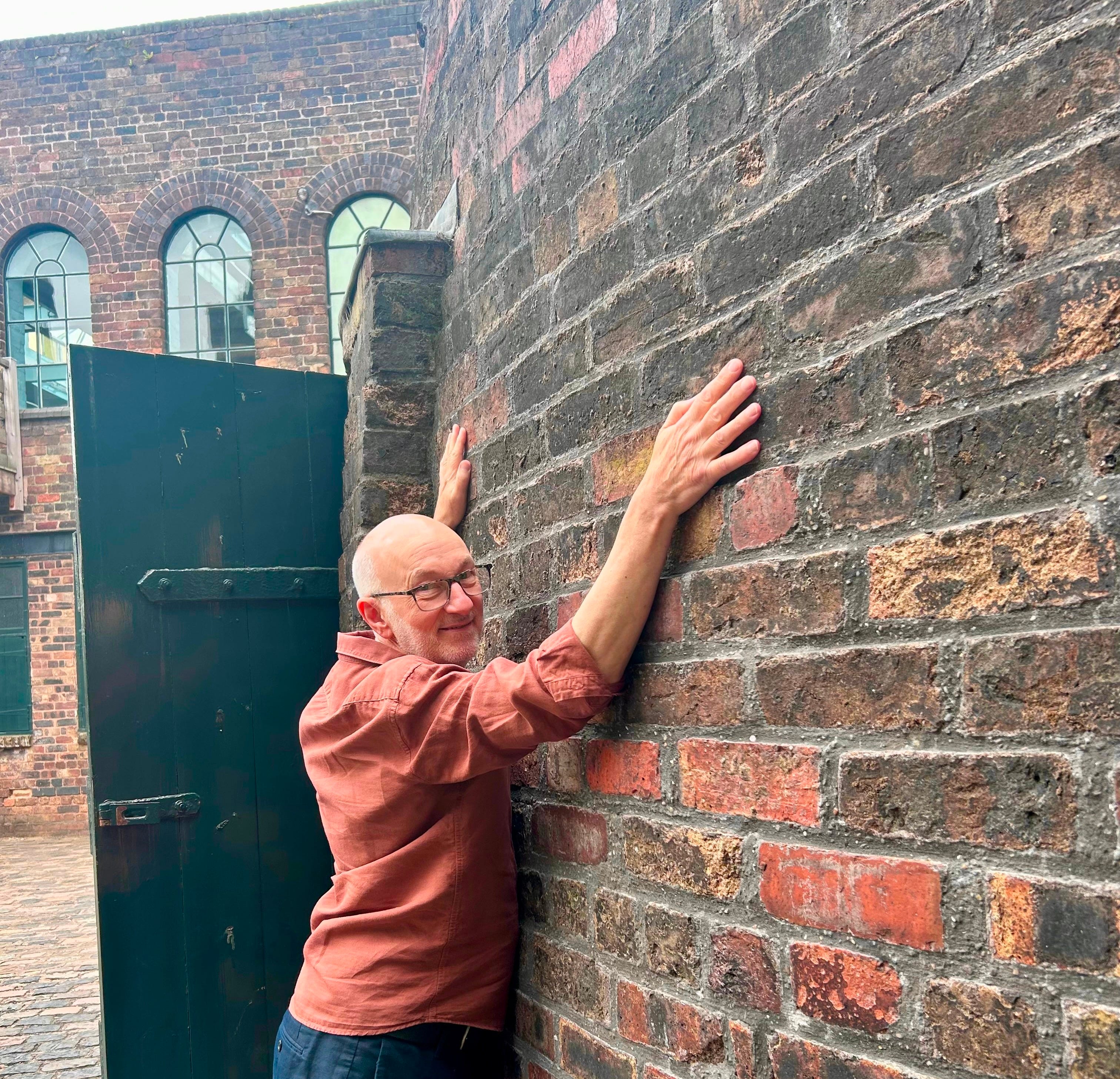

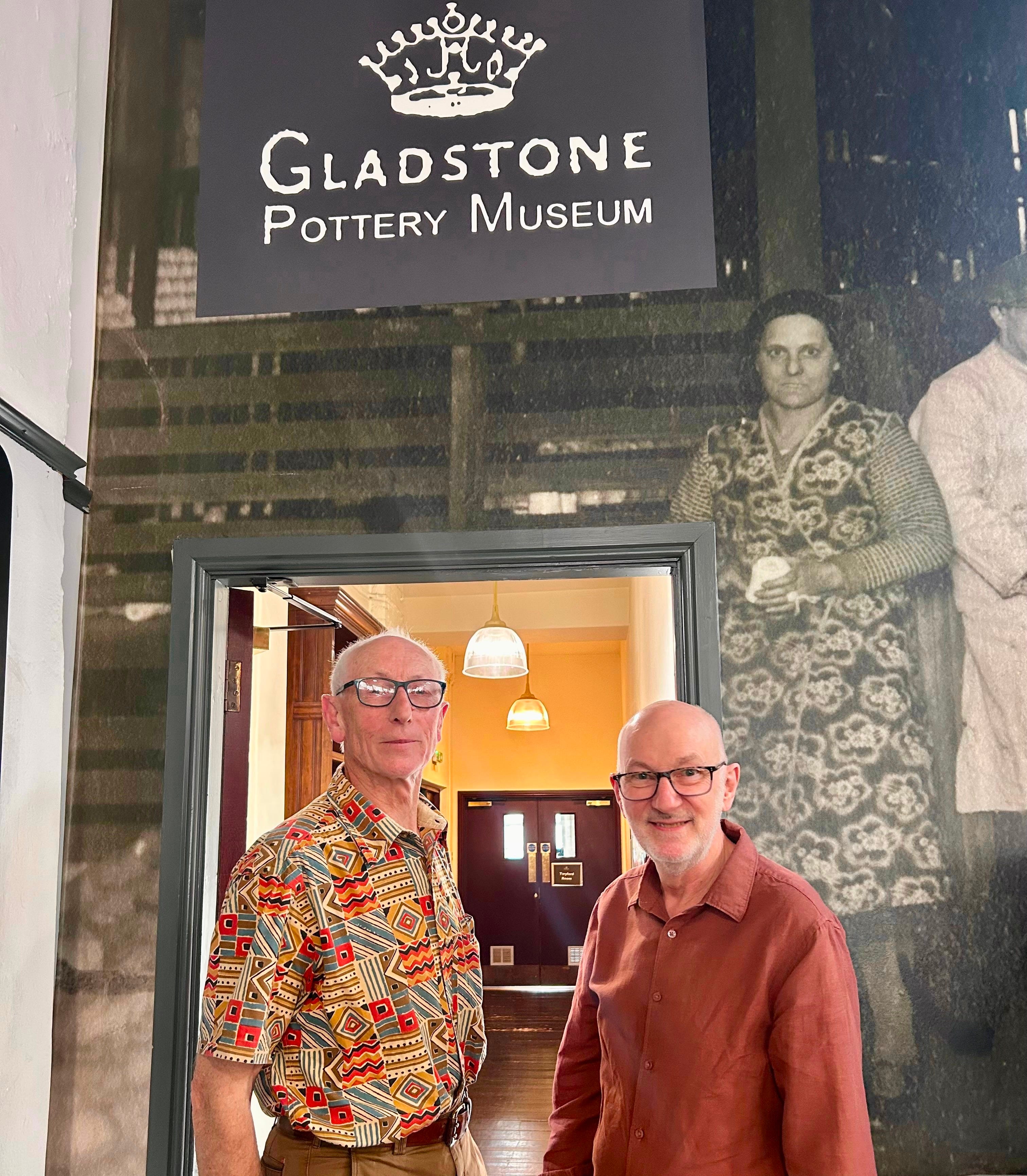
Some people like to hug trees. For Terry Woolliscroft, it’s the bottle ovens at Gladstone, where he’s been volunteering for 53 years. He throws his arms around the bricks with a grin while his brother-in-law, Paul Niblett, always ready with a smile and an anecdote for guests wandering round the museum, looks on. Between them they’ve spent more than a century volunteering at Gladstone.
Former Wedgwood man Terry is not only a volunteer but also co-author of Bottle Ovens & the Story of the Final Firing (2018) with his wife Pam, and creator of several websites including a page dedicated to bottle ovens, and a potbank dictionary that began life in a notebook in 1968 and features almost 1,800 terms and counting.
Terry must arguably rank as one of Stoke’s biggest bottle oven fans. “I can’t keep bottle ovens out of my mind, to be honest. I started the Bottle Oven Art Club during lockdown and that involved loads of people locally. About 100 people got involved and signed up to the Bottle Oven Art Club, and we had an online exhibition,” he begins.
Thanks to his contributions to helping shape the city’s identity, he features on the 100 Faces mural just above Robbie Williams – although he wasn’t there for the unveiling. “They forgot to invite me to the big opening. I was looking through the list and I thought, ‘Bloody hell, that’s me!’” Over the course of the two hours while we chat, I find this is typical Terry – modest, funny, and quietly unassuming, the perfect counterpoint to his more outgoing brother-in-law, who loves providing colour and background to the Gladstone story to guests.
It’s a bright, sunny July day when I meet Terry and Paul for a coffee at the museum, then wander outside for some photos, when there are just a handful of visitors before the school holidays kick off. He cosies up to Bottle Oven No 1, arms wrapped as far as they can around the 175-year old, 60-foot high oven once used for the initial firing of china as I try, and fail, to capture the enormity of this great piece of history.
Terry and his brother-in-law Paul, a former Michelin engineer who’s been here since 1971, have each devoted thousands of unpaid hours to preserving one of Stoke-on-Trent’s greatest pieces of history, the only complete Victorian pottery factory open to the public. “If it wasn’t for the volunteers in the very early days, the museum wouldn’t exist today,” Paul states.
“We were mostly Michelin apprentices. We were looking for a project that we could get involved with” – Paul Niblett, Gladstone volunteer
When the volunteers first walked through the gates in the early 1970s, Gladstone wasn’t the thriving heritage attraction visitors know today. It was a former pottery that needed an enormous amount of work before it could safely open to the public.
“We were mostly Michelin apprentices,” Paul recalls. “We were looking for a project we could get involved with as young engineers.”
Every Thursday evening, after finishing work, they arrived armed with tools to strip out redundant pipework, remove old machinery, and rescue equipment from potbanks that were closing across the city. They sometimes worked alongside young offenders from Werrington detention centre on the weekend, who were rewarded with fish and chips at lunchtime for their efforts.
Looking back, what strikes both men isn’t just what they built, but what they managed to save, and the relationships they formed along the way. Terry met his wife, Pam, a Gladstone curator here, while Paul met Terry’s sister.
As pottery factories closed across Stoke-on-Trent, machinery that had once been at the heart of the industry was heading for the scrapyard. The volunteers travelled from works to works rescuing throwing wheels, lathes, pumps, saggers and countless other pieces of equipment that might otherwise have disappeared forever.
Keeping the Potteries Alive
When Paul first arrived at Gladstone in ‘71, there were no guided tours, no school visits and no television crews filming pottery competitions. There was simply work to be done. The museum wouldn’t officially open until 1975, giving volunteers just a few years to help transform the derelict Victorian pottery into somewhere capable of welcoming the public.
“There was always something that needed doing,” Paul recalls. A donated steam engine needed installing. Buildings had to be made safe. Elsewhere, contractors reinforced walls and added buttresses to support structures that had never been designed to welcome thousands of visitors each year.
The volunteers tackled whatever they could. Some brought engineering skills. Others brought muscle. Terry laughs over his cuppa as he remembers becoming part of what the team affectionately called the “heavy brigade”, shifting materials, laying floors and helping wherever extra pairs of hands were needed.
As Stoke-on-Trent’s pottery industry contracted, another task emerged. Factories that had been at the heart of the city’s economy for generations were closing their doors, and with them came the risk that irreplaceable machinery would simply disappear.